Philippine Airlines A350 Business Class Falls Short
The new cabin has excellent seats and decent food, but unreliable Wi-Fi and an unengaged crew hurt the experience.

A promising flagship flight
The long-haul journey from Manila to San Francisco lasted 11hr55min and offered an early look at Philippine Airlines’ new flagship aircraft. The Airbus A350-1000 arrived with entirely redesigned cabins, making this business-class flight a particularly anticipated part of a return itinerary that began in Osaka and continued through Manila.
The aircraft itself made a strong first impression. Its business cabin felt fresh, and the seat provided the comfort expected on an extended overnight journey. Yet the overall experience never fully matched the promise of the new hardware. Good meals and an impressive seat were offset by an internet connection that did not work and service that lacked energy. The result was a flight that represented solid value without feeling like a fully developed top-tier premium product.
Booking the journey
Both return segments were purchased together on a single ticket. PR411 was scheduled to leave Osaka at 3:15PM on 9/19 and reach Manila at 6:40PM. The connecting service, PR104, had an 11:15PM departure from Manila and a planned San Francisco arrival at 9:10PM.
The full itinerary was priced at $1,746.63. Instead of paying that amount directly, the booking was covered using Chase Ultimate Rewards points. A total of 116,442 points was redeemed at a value of 1.5 cents per point. Given Philippine Airlines’ tendency to price below competing options, the fare helped strengthen the case for the product despite its shortcomings. The first segment used an Airbus A330, while the transpacific leg was operated by the newer Airbus A350.
A difficult Manila departure
The experience before boarding did little to elevate the trip. The Philippine Airlines Mabuhay Lounge Manila was disappointing enough that sitting in the terminal seemed preferable. Terminal 1 itself also made for an unpleasant setting before the flight.
PR104 was assigned to gate five. Boarding was due to begin at 10:30PM, which was 45 minutes ahead of departure. Flights bound for the US left from a common section reached through a centralized security checkpoint. The process was quick in this instance, although passengers whose boarding passes carried “SSSS” faced a more extensive inspection.
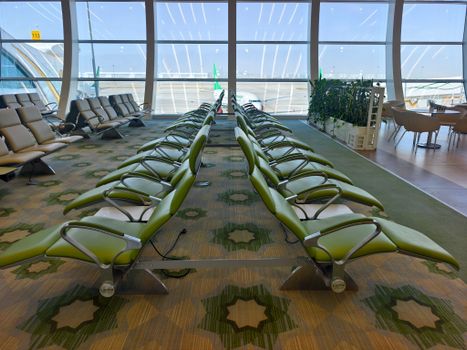
Around the gates, a large field of closely arranged seating made movement difficult, particularly when several services were preparing to depart during busy periods. Business-class travelers had their own seating section, but it offered no notable added comfort. Boarding started at the scheduled time with dozens of passengers using wheelchairs. The business-class group followed roughly 15 minutes afterward, by which point about half of the premium cabin was already occupied.
Excellent seating
Passengers entered through the forward left door and turned right into business class. The A350-1000 uses the Collins Aerospace Elevation seat, an updated and renamed version of the Super Diamond design. Its reverse-herringbone layout gives each traveler a private, well-defined space and provides the cabin’s clearest competitive strength.
Each seat measures 21 inches across and provides 44 inches of pitch. When converted for sleeping, it becomes a fully flat bed measuring 78 inches. There are 42 business-class seats in total. These dimensions, combined with the cabin’s new condition, made the physical product highly suitable for a flight of this length.
Value without polish
Food aboard the flight was fairly good, reinforcing the sense that the fundamentals were in place. The larger weaknesses came from the service surrounding those fundamentals. Wi-Fi was unavailable because the system was not operating, removing a useful amenity on a journey approaching 11hr55min.
The crew remained friendly, but the interaction lacked the warmth and close attention experienced on the previous flight. Service appeared routine and detached rather than genuinely engaged. That missing personal element mattered because the aircraft and seat had established much higher expectations.
For travelers primarily concerned with a comfortable bed and a competitive fare, the A350-1000 business cabin can still be an attractive option when the price is favorable. Philippine Airlines has assembled strong hardware and acceptable catering, but the Manila ground experience, failed connectivity and indifferent-feeling service prevent the journey from reaching its full potential.
- The Manila to San Francisco flight lasted 11hr55min.
- The two-flight ticket cost $1,746.63.
- The booking used 116,442 Chase Ultimate Rewards points.
- Business class has 42 seats and 78-inch flat beds.
- PR104 was scheduled to depart Manila at 11:15PM.
Source: One Mile at a Time ↗
Summarized from the reporting above. Read it for the full story.
Winter weeks, altitude, and a fire at the end of the day. Tell us what the trip should feel like and we'll shape complete options you can compare.
Ask 4Vacations →

Share this story